Reviewing the Welcome Chocolate SVG for Embroidery
As a designer who has spent countless hours digitizing files and testing them on everything from stiff denim to delicate baby knits, I approach every new machine embroidery design with a critical eye. We have all seen those cute digital assets that look perfect on a screen but turn into a tangled mess of thread breaks and puckering once they hit the fabric. Today, I am taking a close look at the Welcome I Hope You Brought Chocolate SVG, a piece that falls squarely into the humor and home decor niche within Crafts and Graphics.
This is not just about whether the file opens correctly; it is about whether this design holds up in a real-world production environment. If you are an Etsy seller, a boutique owner, or a hobbyist looking to create high-quality handmade products, you need to know if this asset is worth your time, thread, and stabilizer.
First Impressions and Visual Personality
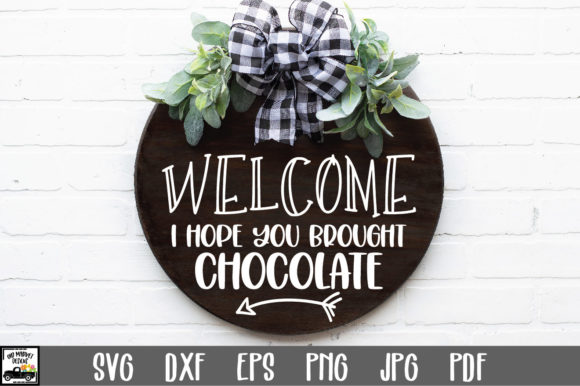
The first thing that strikes me about the Welcome I Hope You Brought Chocolate SVG is its tone. It is playful, slightly sassy, and immediately relatable. The layout, described as a funny round sign, suggests a contained, badge-like aesthetic. In the world of embroidery, circular or badge-style designs are incredibly versatile because they fit naturally into standard hoop sizes without requiring complex positioning.
The mood here is casual hospitality. It is not the stiff, formal welcome mat vibe; it is the "come in, but bring snacks" energy that modern homeowners love. For a designer, this means the typography needs to be legible and the spacing balanced. Since the product description notes it includes formats like SVG, DXF, EPS, PNG, JPEG, and PDF, we are dealing with a vector-based origin. This is crucial for scalability. However, as embroiderers, we must remember that vector smoothness does not always translate to stitch clarity. The black colorway mentioned in the file details suggests a high-contrast look, which is excellent for readability but requires careful thread selection to avoid looking too harsh on light fabrics.
Real-World Application: The Tote Bag Test
To truly evaluate this design, I imagined a specific client project: a custom canvas tote bag for a local bakery or a chocolate shop. This is a classic small shop product scenario. The Welcome I Hope You Brought Chocolate SVG would sit perfectly on the front panel of a sturdy cotton tote.
In this context, the design acts as both branding and humor. When stitching onto canvas, the stitch density becomes a primary concern. If the original graphic has dense fill areas, it could make the fabric stiff. I would recommend using a medium-weight cut-away stabilizer to support the stitches without adding excessive bulk. The round shape of the sign allows for a clean border, perhaps using a satin stitch edge to frame the text, which adds a professional finish that customers associate with higher value.
Another strong candidate for this design is a kitchen towel or apron. Imagine gifting this as part of a housewarming bundle. The humor lands well in a kitchen setting. Here, the thread colors matter immensely. While the file is provided in black, translating this to embroidery might involve using dark brown or deep burgundy threads to mimic chocolate, adding a layer of thematic consistency that elevates the finished product.
Navigating Fabric and Hoop Constraints
Not every surface is friendly to this type of design. While the Welcome I Hope You Brought Chocolate SVG is versatile, there are limitations. If you are planning to use this on a sweatshirt embroidery project, you must account for the nap of the fleece. Small details in the lettering can get lost if the pile is too high. In such cases, increasing the size of the design to ensure the text remains readable is essential.
Curved surfaces, like caps or hats, present another challenge. A round sign design can distort if not centered perfectly on the front panel of a cap. I would advise using a specialized cap frame and ensuring the hoop size matches the design dimensions precisely. If the design is too large, it will wrap around the curve and become unreadable from the side. If it is too small, it may look insignificant.
For baby embroidery or delicate items, caution is key. The humor might appeal to parents, but the stitch density must be low enough to prevent irritation against sensitive skin. Always test on scrap fabric first. Check how the running stitch underlays interact with thin materials. If the design feels heavy, consider simplifying the fill or using an applique design technique where the fabric itself forms the background, reducing the amount of thread on the garment.
Commercial Viability and Brand Trust
For commercial embroidery professionals, the quality of your digital assets directly impacts customer trust. A crisp, well-digitized file results in a clean embroidered patch or garment that looks professional. Sloppy stitching, caused by poor file conversion or ignoring fabric types, can damage your brand reputation.
The inclusion of multiple formats like DXF and EPS in the Welcome I Hope You Brought Chocolate SVG package is a significant advantage. It allows you to import the design into various digitizing software programs if you need to adjust the stitch density or change the stitch types manually. This flexibility is vital for digital product sellers who might offer customization options. You can easily modify the text or colors to match a client’s brand palette, making it a valuable asset for custom apparel orders.
When creating printable mockups for your online store, the high-resolution PNG and JPEG files included allow you to showcase the design on different products without having to stitch every sample physically. This saves time and resources while still providing customers with a realistic preview of the design assets.
Practical Designer Notes for Best Results
Before you start stitching, keep these practical tips in mind:
- Test on Scrap Fabric: Always run a test stitch-out on the same type of fabric you intend to use for the final product. This reveals any tension issues or registration errors.
- Check Thread Contrast: Since the design is humorous and text-heavy, ensure high contrast between the thread and the fabric. Dark threads on light fabrics work best for readability.
- Verify Licensing: Although the file is provided for craft use, always confirm the specific license terms before selling finished items. Some creators allow commercial use of physical products but restrict the resale of the digital file itself.
- Stabilizer Selection: Match your stabilizer to your fabric. Use tear-away for stable woven fabrics and cut-away for stretchy knits or items that will undergo frequent washing.
- Inspect Small Details: Zoom in on the vector file before digitizing or converting. Ensure that small serifs or decorative elements are large enough to be stitched without breaking needles.
In conclusion, the Welcome I Hope You Brought Chocolate SVG is a charming addition to any designer’s library. It offers a blend of humor and style that resonates with modern consumers. By paying attention to fabric choice, stitch density, and proper stabilization, you can transform this digital graphic into a standout personalized gift or a best-selling item in your craft business. It is a reminder that even simple designs, when executed with care, can bring joy and professionalism to your embroidery projects.